
The day and night cycle your body has been waiting for
We tend to think of stress and sleep as separate problems. Something to manage during the day, something to chase at night. But the body doesn't make that distinction. What happens in your waking hours directly shapes how you restore, and how you restore shapes how resilient you are the next day. Miss one half of the equation, and the other suffers. This is what the science has been telling us for years. It's also the idea at the heart of DIOME.
Why stress and sleep can't be solved in isolation
Stress is more than a feeling. It is a full-body physiological event, one that activates the cardiovascular system, the nervous system, the gut, and the neuroendocrine system simultaneously. When you encounter a stressor, the hypothalamic-pituitary-adrenal (HPA) axis triggers a cascade of hormonal signals, with cortisol as its primary output. In short bursts, this is useful. Cortisol sharpens focus, mobilises energy, and prepares the body to respond.
The problem is chronic exposure. When cortisol remains elevated across the day, as it does under sustained modern pressure, the body cannot complete its recovery cycle. Cortisol has a natural diurnal rhythm: high in the morning to support waking alertness, falling through the afternoon, and reaching its lowest point at night to allow melatonin to rise and sleep to begin. Sustained stress disrupts that rhythm. Cortisol stays elevated when it should be falling. And when it does, the conditions for restorative sleep never fully arrive.
Published research confirms that HPA axis dysregulation is one of the most consistent physiological features of chronic insomnia, and that the relationship runs in both directions. Poor sleep elevates cortisol. Elevated cortisol disrupts sleep. Without intervention at the level of the stress response itself, the cycle simply continues.
What actually happens when you don't restore properly
Sleep is not passive. It is the most metabolically active period of recovery the body has. During deep sleep, the brain's glymphatic system — only discovered in 2013 — flushes metabolic waste products, including proteins associated with neurodegeneration. Growth hormone is released, triggering cellular repair. The immune system consolidates its defences. The nervous system recalibrates.
When sleep is fragmented or insufficient, these processes are cut short. A landmark study by Spiegel et al., published in The Lancet, found that just one week of sleep restricted to six hours per night was enough to alter glucose metabolism, increase cortisol levels in the evening, and elevate inflammatory markers. In other words, poor sleep doesn't just leave you tired. It shifts your physiological baseline in ways that compound over time.
The implications are significant. Elevated evening cortisol from insufficient sleep makes it harder to fall asleep the following night. Impaired cellular repair from disrupted deep sleep accumulates as fatigue, cognitive dulling, and reduced stress tolerance. The body becomes progressively less equipped to handle what the next day demands — which generates more stress, which further disrupts sleep. Round and round.
Why the daytime half of the equation matters as much as the night
Most approaches to sleep focus on what happens at bedtime: a magnesium supplement, a wind-down routine, a melatonin gummy. These are not without value. But they address the problem at the end of the day, when the physiological conditions for rest have already been shaped by everything that came before.
Supporting the stress response during the day is not a secondary concern. It is the precondition for genuine restoration at night. When the nervous system has been given what it needs to regulate through the day — when cortisol follows its natural arc rather than staying elevated — the transition into sleep becomes something the body does naturally, rather than something you have to engineer.
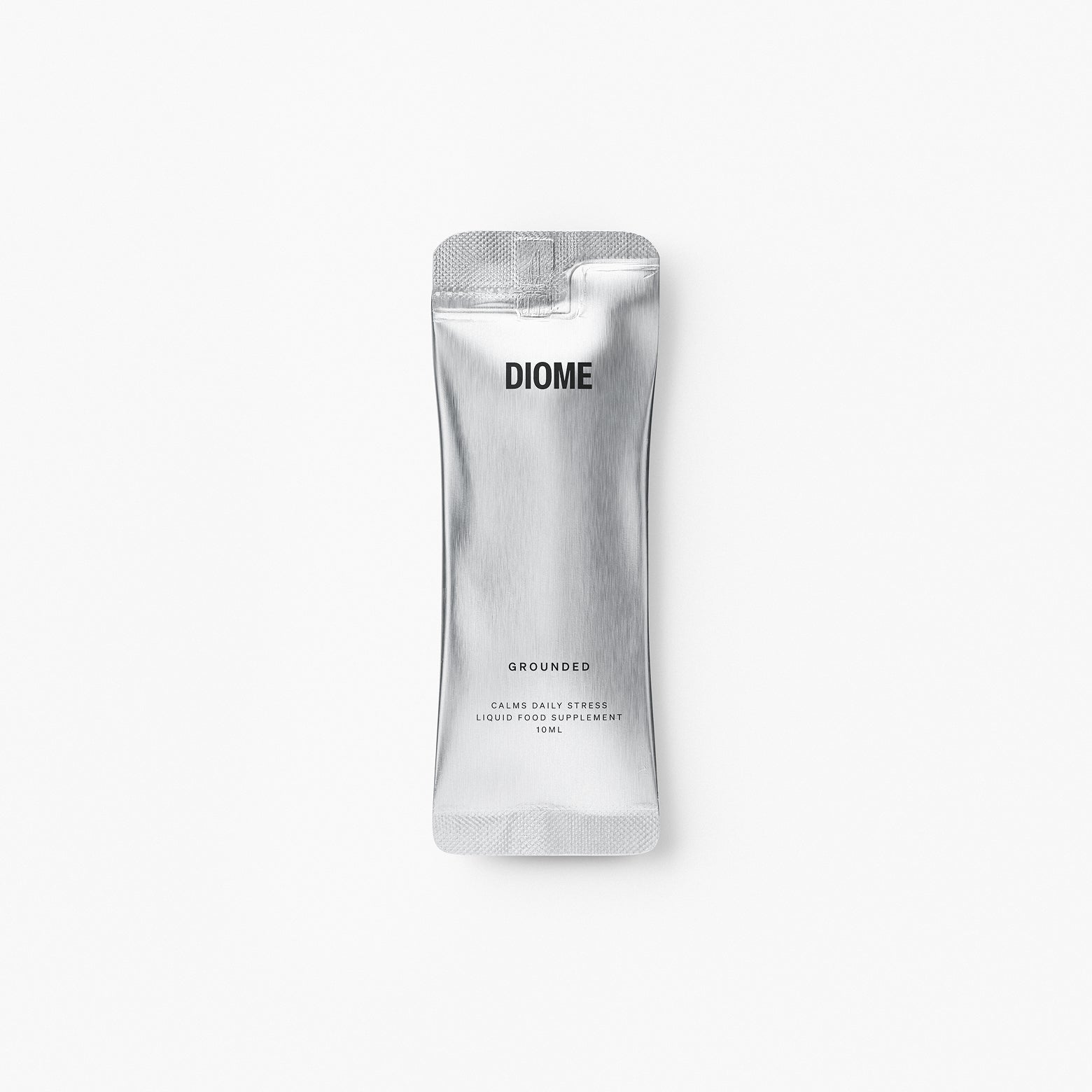
This is the logic behind Grounded, DIOME's daytime formula. Four botanical extracts (hawthorn, lemon balm, California Poppy, and passionflower) work across the cardiovascular, nervous, digestive, and neuroendocrine systems simultaneously, addressing stress as the whole-body event that it is. Rather than sedating or dulling, the formula supports the body's own regulatory capacity: helping the nervous system return to baseline more quickly, easing the cardiovascular dimension of the stress response, and calming the gut-brain axis that so often carries the physical weight of a difficult day.
The liquid sachet format is not incidental. Liquid delivery enables faster absorption than any solid form, and when stress is already present, speed matters. Uniquely, an essential oil complex of Lavender, Lemon, and Bergamot activates the olfactory pathway on the first breath, sending a calming signal to the limbic system before a single botanical has been absorbed. In an independent real-life UK study conducted on 100 participants under medical supervision, 96% reported a perceived benefit within 15 minutes.
What Rested does and why it works differently from most sleep supplements
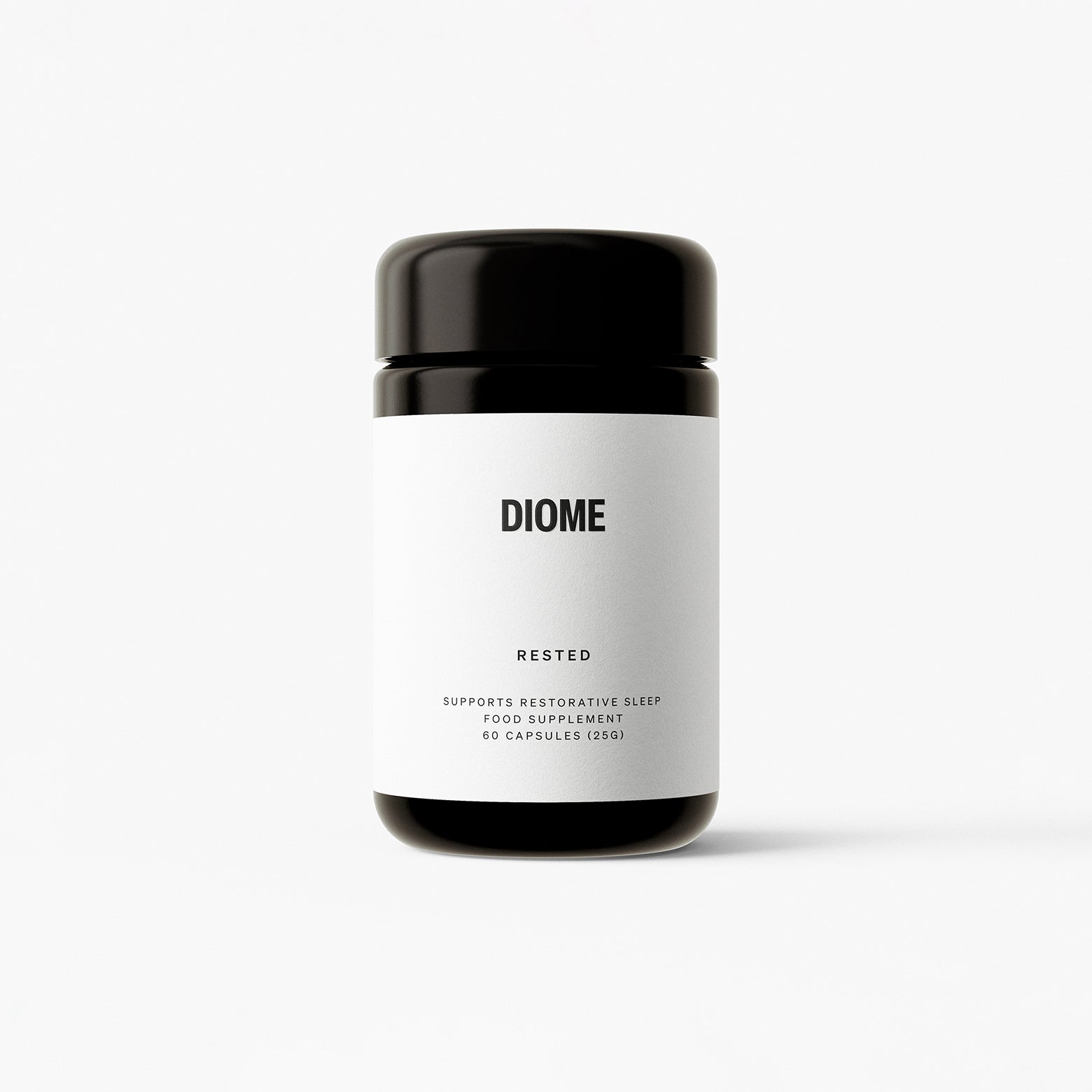
Rested, DIOME's night-time formula, was developed on the same foundational principle: support the body's own systems rather than override them. This distinction matters, particularly in a market saturated with melatonin-based products.
Exogenous melatonin taken as a supplement signals the brain that it is time to sleep, but it does not address the physiological conditions that determine sleep quality. It also raises questions about long-term impact on the body's own melatonin production, with some research suggesting that regular supplementation may suppress endogenous synthesis over time. Rested contains no melatonin. Instead, its fifteen ingredients (seven botanical extracts, four B vitamins, three minerals, and myo-inositol) work across the nervous system, digestive tract, and cellular recovery pathways to support the conditions in which deep, restorative sleep can occur naturally.
The results from DIOME's independent real-life study, conducted on 100 adults in the UK in 2025 under medical supervision, are unambiguous: 93% reported enhanced sleep quality or fewer sleep disturbances; 85% gained an average of over 50 additional minutes of sleep within the first week; 92% saw a positive impact on their mental and physical wellbeing.
The 24-hour system
What makes the DIOME approach structurally different is that neither product was designed to work in isolation. Grounded and Rested were developed in tandem by the same medical doctor, as two complementary halves of a complete physiological system.
Grounded manages what accumulates during the day: the cardiovascular tension, the nervous system dysregulation, the cortisol that rises and struggles to fall. Rested supports what the body needs at night to complete its recovery cycle: supporting healthy sleep patterns, restoring cellular function, and protecting the neurological and hormonal systems that stress erodes.
Together, they address the modern stress-sleep cycle at its root. Not by sedating, not by overriding the body's chemistry, but by supporting the capacity the body already has to regulate by day, restore by night, and build the resilience to meet the next day better than the last.
That compounding effect is the point. Resilience is not built in a single night. It is built across 24 hours, accumulated over time.
Sources
Spiegel, K., Leproult, R., & Van Cauter, E. (1999). Impact of sleep debt on metabolic and endocrine function. The Lancet, 354(9188), 1435–1439.
Vgontzas, A.N., Bixler, E.O., Lin, H.M., Prolo, P., Mastorakos, G., Vela-Bueno, A., Kales, A., & Chrousos, G.P. (2001). Chronic insomnia is associated with nyctohemeral activation of the hypothalamic-pituitary-adrenal axis. Journal of Clinical Endocrinology & Metabolism, 86(8), 3787–3794.
Iliff, J.J., Wang, M., Liao, Y., Plogg, B.A., Peng, W., Gundersen, G.A., Benveniste, H., Vates, G.E., Deane, R., Goldman, S.A., Nagelhus, E.A., & Nedergaard, M. (2012). A paravascular pathway facilitates CSF flow through the brain parenchyma and the clearance of interstitial solutes, including amyloid β. Science Translational Medicine, 4(147), 147ra111.
Arendt, J., & Skene, D.J. (2005). Melatonin as a chronobiotic. Sleep Medicine Reviews, 9(1), 25–39.
Buckley, T.M., & Schatzberg, A.F. (2005). On the interactions of the hypothalamic-pituitary-adrenal (HPA) axis and sleep: Normal HPA axis activity and circadian rhythm, exemplary sleep disorders. Journal of Clinical Endocrinology & Metabolism, 90(5), 3106–3114.